





As organizations navigate complexity, change, and talent retention challenges, a critical question emerges: What separates high-performing, engaged individuals and teams from those struggling with turnover and disengagement? The answer increasingly points to emotional intelligence. The Genos Workplace Model of Emotional Intelligence provides organizations with a practical, research-backed framework for developing the EI (Emotional Intelligence) competencies that drive business outcomes and create thriving work environments.
What is the Genos Workplace Model?
The Genos Workplace Model of Emotional Intelligence comprises a set of six emotionally intelligent competencies that are specifically designed to enhance professional performance and workplace communication. The Genos model focuses on behaviors and skills that are directly observable, measurable, and most importantly purposely designed to be applicable in professional contexts.
Research has consistently shown that emotional intelligence underlies success at work. In high-performing organizations, employees feel significantly more engaged, valued, cared for, and motivated. Conversely, in underperforming organizations, employees often experience stress, fear, and uncertainty. The Genos Workplace Model provides a framework with which employees at all levels of an organization can positively improve professional relationships, productivity, and organizational culture.
For professionals designing and implementing talent development initiatives (internal learning and development leaders, external consultants, organizational coaches, HR strategists, trainers, organizational psychologists, or business owners) the Genos Workplace Model provides a shared language and validated framework for emotional intelligence that can be embedded into development programs, leadership initiatives (especially those geared toward individuals identified as future leaders), performance management systems, and organizational culture work.
The Six Core Competencies
The Genos Workplace Model identifies six core emotional intelligence competencies,each comprising seven emotionally intelligent workplace behaviors. Frequent demonstration of these behaviors and competencies correlates with productive outcomes such as effective workplace performance, enhanced team working and increased engagement. By developing these competencies systematically across an organization, you create consistent behavioral shifts that directly impact performance and culture.
1. Self-Awareness
The foundation of emotional intelligence. Self-aware individuals recognize their own emotions, biases, strengths, and areas for growth. They understand how their emotions influence their thinking and behavior.
Productive: Self-aware, Present
Unproductive: Defensive, Disconnected
Why it matters organizationally: Employees with strong self-awareness make better decisions, respond more constructively to feedback, and model accountability. These qualities strengthen team effectiveness and psychological safety.
2. Awareness of Others
The ability to perceive, understand, and acknowledge how others feel. Individuals with high awareness of others are empathetic, can pick up on non-verbal cues, and respond to others' emotional needs appropriately.
Productive: Empathetic, Connected
Unproductive: Detached, Insensitive
Why it matters organizationally: Teams where members demonstrate awareness of others experience higher psychological safety, improved communication, and stronger collaboration, which are especially critical in hybrid and remote work environments.
3. Authenticity
Expressing yourself genuinely, openly, and at the right time and to the right degree. Authentic individuals honor their commitments, communicate clearly, and build trust with others through transparent behavior.
Productive: Genuine, Trustworthy
Unproductive: Untrustworthy, Guarded
Why it matters organizationally: Authenticity builds organizational trust and creates environments where people feel safe to contribute their best thinking.
4. Emotional Reasoning
The ability to combine emotional information with factual and technical data to make well-rounded decisions. Emotions contain valuable insights that, when integrated with logical analysis, lead to more effective outcomes.
Productive: Balanced Decision-making
Unproductive: Dismissive of Emotions, Limited decision-making
Why it matters organizationally: Leaders and teams that integrate emotional reasoning make better strategic decisions, consider the human impact of these decisions and earn buy-in, and achieve more sustainable outcomes.
5. Self-Management
Managing one’s own mood, emotions, time, and behavior. In today's high-demand workplace, individuals with strong self-management are resilient, optimistic, and able to find opportunities even in adversity.
Productive: Resilient, Adaptable
Unproductive: Temperamental, Reactive
Why it matters organizationally: A leader's emotional state is contagious. Self-management at all levels sustains performance, reduces burnout, improves decision-making under pressure, and creates more stable, resilient teams and organizations.
6. Positive Influence
Positively influencing how others feel through problem-solving, feedback, and recognition. This involves creating a supportive work environment, helping others respond effectively to challenges, and recognizing achievements.
Productive: Empowering, Supportive
Unproductive: Indifferent, Detached
Why it matters organizationally: Teams where positive influence is demonstrated see higher engagement, stronger psychological safety, and greater willingness to embrace change.
How the Model Works
The Genos Workplace Model is grounded in the understanding that the demonstration of each emotional competency exists along a spectrum. When demonstrated frequently, you have productive emotional states and behaviors. These qualities lead to better work relationships and higher performance. On the other side of the model, where the behaviors and competencies are demonstrated less frequently, you have unproductive emotional states. These patterns can undermine collaboration and performance.
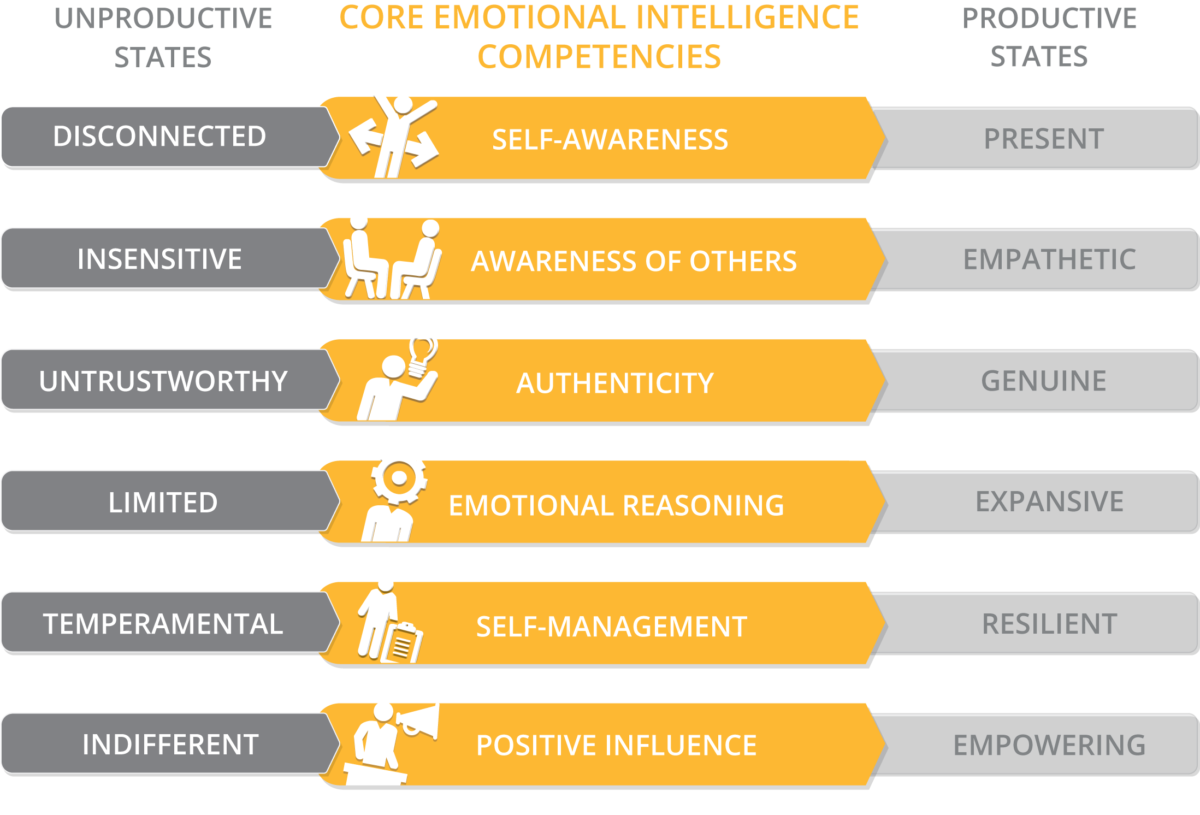
Everyone experiences both productive and unproductive emotional states at different times. The goal is developing the awareness and skills to spend more time in productive states (by demonstrating the competencies and behaviors more frequently) and to recognize and manage unproductive patterns more quickly. This is true for individuals, teams, and entire organizations.
The best part? These competencies are:
- Measurable: They can be assessed through validated instruments that provide objective feedback on how teams and individuals are currently demonstrating these behaviors.
- Observable: Others can see these behaviors demonstrated (or not) in daily interactions, making them clear measures for development and feedback.
- Developable: Unlike personality traits, these competencies can be strengthened through learning, awareness, action-planning, application, and intentional effort.
- Business-relevant: Each competency directly impacts workplace effectiveness, collaboration, performance, engagement, and retention.
Developing Emotional Intelligence at the Organizational Level
Emotional intelligence competencies can be learned and developed, meaning they're not fixed attributes but skills that can be systematically strengthened across your organization. Here's how to approach EI development strategically:
Assessment and Feedback: The Foundation for Development
The Genos Emotional Intelligence Workplace Assessment provides behavior-based feedback on how well individuals and teams are currently demonstrating emotionally intelligent behavior as compared to relevant benchmarks: a global benchmark as well as internal benchmarks. This objective data is the essential starting point for any development initiative because it:
- Identifies individual, team and organizational development priorities
- Reveals strengths to build upon and opportunities for growth and development
- Creates accountability by moving from perception to evidence
- Enables benchmarking across departments and over time
- Provides the foundation for targeted, relevant program design
Organizations can implement assessments using external professionals that are certified to administer Genos Assessments (Genos Certified Practitioners) or build in-house facilitation teams by certifying team members through the Genos Certification Course. The Genos Workplace Assessment is designed to be both affordable and scalable, allowing organizations of all sizes to access research-backed EI measurement without prohibitive costs. This accessibility means even organizations with limited budgets can implement meaningful EI development initiatives.
For organizations committed to sustaining EI development long-term, building internal expertise is a strategic investment that embeds emotional intelligence into your culture and ensures continuity.
Targeted Development Programs Scaled Across Your Organization
Programs like Applied Emotional Intelligence are specifically designed for organizations wanting to implement long-lasting EI development initiatives. These programs work because they:
- Are grounded in social neuroscience research
- Provide practical tools for managing emotions and improving workplace relationships
- Can be scaled across departments, teams, and organizational levels
- Create a shared language and consistent approach to EI development
- Translate awareness into behavioral change through practice and application
Creating a Culture Where Emotional Intelligence Thrives
Organizations that embed emotional intelligence into their learning framework and culture see the strongest, most sustainable results. When staff and leaders model EI competencies and the organization recognizes and rewards their demonstration, EI development becomes self-sustaining. It shifts from being a program to being integrated into how the organization operates.
Here are some ways that successful organizations embed EI into their company culture:
- Performance management systems that recognize and reward high levels of demonstrated EI
- Leadership development programs specifically designed to develop EI
- Team effectiveness initiatives that target specific EI competencies
- Feedback and coaching processes grounded in EI
- Organizational values and recognition systems that reinforce emotional intelligence development
Unlike lengthy certification programs, Genos Certification is designed for busy professionals, allowing you to add validated EI expertise to your practice quickly, in just 3 sessions, or via a Self-Paced Course, while continuing your current work. This means you can start delivering Genos-based solutions to your clients or organization without extended time away from your many responsibilities.
Measuring Impact and understanding the ROI
Progressive organizations track EI development outcomes to understand business implications of EI development and refine their approach. They might track:
- Engagement scores and changes over time
- Voluntary turnover in key roles and departments
- Internal promotion and retention rates
- Team collaboration and psychological safety metrics
- Performance improvements linked to development initiatives
- Leadership effectiveness and 360-degree feedback outcomes
Connecting EI development to business metrics helps secure ongoing investment and demonstrates the real value of your initiatives.
Why The Genos Emotional Intelligence Models Matter Now
In our world of continuous change and uncertainty, remote and hybrid work complexity, talent acquisition and retention pressures, and increasing organizational complexity, emotional intelligence has never been more important. For professionals designing organizational strategies and development initiatives, the Genos Workplace Model of Emotional Intelligence provides:
- Clarity: A clear, research-backed framework for understanding what emotional intelligence looks like in practice, making it easier to communicate the "why" and "how" to stakeholders
- Measurability: The ability to assess where the organization currently stands and track development progress over time.
- Actionability: Specific, behavior-based competencies that can be targeted, coached, and improved.
- Business Impact: Direct connection to performance, engagement, retention, resilience, and organizational success.
Research consistently demonstrates that high levels of emotional intelligence boost career success, mental health and well-being, and overall organizational health. Organizations that develop emotional intelligence in their workforces see measurable improvements in employee retention, productivity, culture, change management effectiveness, and resilience during uncertainty.
Ready to Build Emotional Intelligence Across Your Organization?
For organizational leaders, HR professionals, learning and development practitioners, coaches, consultants, trainers, and organizational psychologists, the Genos Workplace Model and validated assessments provide the foundation for sustainable EI development that improves engagement, retention, collaboration, and performance.
Whether you're implementing your first EI program, scaling existing initiatives, or seeking to deepen your expertise in emotional intelligence development, we can help.
Learn more about:
- The Genos Workplace Assessment and how it can inform your development strategy
- Applied Emotional Intelligence and other development programs
- Genos Emotional Intelligence Certification
- Custom organizational solutions with Genos Unlimited
Schedule a conversation to explore how the Genos suite of Emotional Intelligence Solutions can drive results in your organization.
